




Le récit le plus bruyant autour de l’IA et de la main-d’œuvre est celui de la perte d’emploi. Les données de notre dernière enquête sur les dépenses technologiques des entreprises racontent une histoire plus ancrée.
Lorsque nous avons demandé à 100 grands dirigeants technologiques d’entreprise comment leurs organisations équilibrent les investissements en IA avec le recrutement humain, 73 % ont répondu que l’IA complète soit uniquement les équipes existantes sans réduire le nombre de personnels, soit n’a eu aucun effet mesurable sur le recrutement. Seuls 18 % ont décrit une réduction totale — 14 % ont déclaré que l’IA ralentissait les embauches dans certains départements, et seulement 4 % étaient en pause ou en gel complet.
L’augmentation, pas le déplacement, est le titre que nous voyons.
Les équipes ne rétrécissent pas. Ils tournent.
La réponse la plus courante, avec 41 %, était que l’IA conduit à une réallocation des priorités d’embauche : moins de postes traditionnels, plus axés sur l’IA. Le profil des personnes embauchées évolue même lorsque le total des employés ne change pas. Des ingénieurs capables de travailler aux côtés des systèmes d’IA, Analyst capables d’interpréter les résultats des modèles, d’opérateurs capables de gérer et d’évaluer les agents — ces rôles sont en hausse. Les postes débutants axés sur des tâches répétitives et basées sur des règles diminuent.
La couche agente renforce l’histoire
En regardant spécifiquement l’IA agentique, le tableau reste cohérent. Quatre-vingt-quinze pour cent des organisations s’attendent à ce que l’IA agente ait un impact significatif sur les flux de travail des entreprises au cours de l’année à venir — mais presque aucune ne s’attend à ce que cet impact soit principalement un remplacement. Quarante-deux pour cent des répondants s’attendent à ce que les agents complètent principalement les flux de travail humains existants. Cinquante-trois pour cent s’attendent à un équilibre entre augmentation et un peu d’automatisation. Seulement 1 % s’attend à ce que l’IA agente remplace principalement les flux de travail humains.
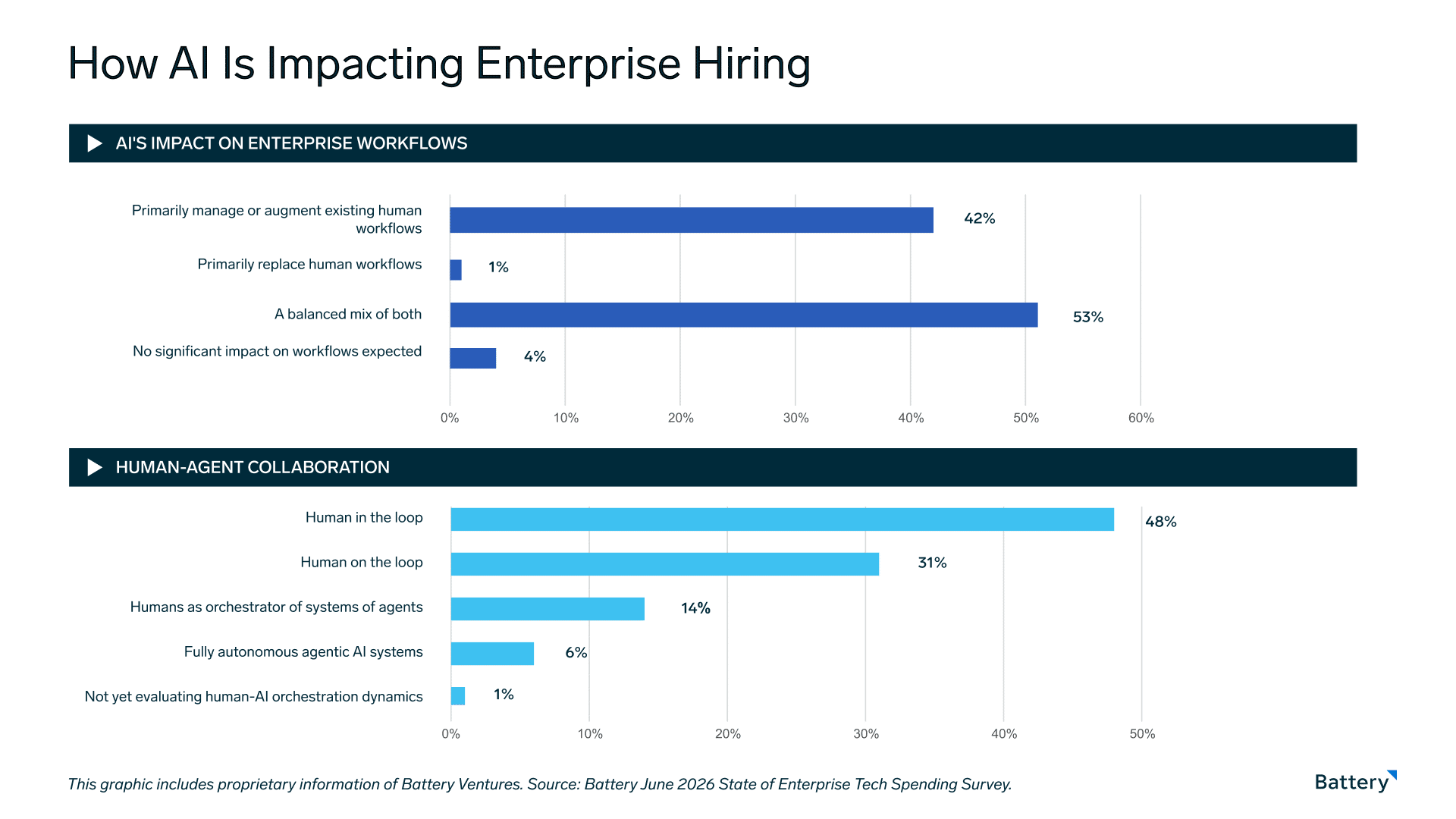
Même lorsque les organisations déploient des agents autonomes pour gérer des tâches précédemment exécutées par les humains, l’attente dominante est que les humains restent centraux en tant qu’organisateurs, évaluateurs et décideurs. Le travail change, mais la main-d’œuvre reste en grande partie.
Qui dirige le navire
Bien que l’IA ait transformé la façon dont les gens fonctionnent, le leadership formel de l’IA reste concentré sur les fonctions technologiques. Seuls 25 % des entreprises disposent aujourd’hui d’un Chief AI Officer en poste, tandis que 9 % supplémentaires prévoient d’en nommer un dans les 12 mois. La majorité, 54 %, a conservé la responsabilité de l’IA sous la direction technologique existante. Parmi ceux-ci, le DSI dépasse le CTO en détention complète, 32 % contre 29 %.
Ce qui est notable, c’est à quel point cette gouvernance a peu touché la fonction humaine au sein de l’entreprise. Les RH ne possèdent aucune stratégie d’IA dans aucune organisation interrogée, et la majorité affirme que les RH n’ont aucune implication — malgré le fait que l’IA soit la force la plus importante qui remodele actuellement la planification de la main-d’œuvre.
C’est un écart structurel. Les décisions de déploiement de l’IA sont prises dans les fonctions technologiques, mais leurs conséquences sur la main-d’œuvre se répercutent ailleurs.
Le prochain défi
Le récit du remplacement peut être plus fort que ce que les données justifient. Le défi auquel les entreprises doivent réellement faire face est plus durable : comment construire et retenir des équipes conçues pour travailler avec l’IA, et pas seulement en parallèle.
À mesure que les organisations passent de l’expérimentation en IA générative au déploiement agentique, réduire l’écart entre le lieu où les décisions IA sont prises et l’impact sur la main-d’œuvre aura plus d’importance, et non moins.
Cet article fait partie de la série Rapports de Dépenses d’Entreprise 2026 de Battery. Téléchargez le rapport complet.
Les informations contenues dans ce commentaire sur le marché sont basées uniquement sur les opinions de Nick Elsner, Scott Goering et Evan Witte, et rien ne doit être interprété comme un avis d’Investissements. Ce matériel est fourni à titre informatif et ne peut être utilisé en aucun cas comme conseil juridique, fiscal ou d’investissements, ni comme offre de vente ou sollicitation d’achat d’une participation dans un fonds ou véhicule Investissements géré par Battery Ventures ou toute autre entité Battery . Les opinions exprimées ici sont uniquement celles des auteurs.
Les informations ci-dessus peuvent contenir des projections ou d'autres déclarations prospectives concernant des événements ou des attentes futurs. Les prévisions, opinions et autres informations présentées dans cette publication sont susceptibles d'être modifiées en permanence et sans préavis d'aucune sorte, et peuvent ne plus être valables après la date indiquée. Battery Ventures n'assume aucune obligation et ne s'engage pas à mettre à jour les déclarations prévisionnelles.










Un bulletin d'information mensuel pour partager de nouvelles idées, des aperçus et des introductions pour aider les entrepreneurs à développer leurs entreprises.